
Knowing how to do a stock take properly is mostly about what happens before anyone starts counting. The problems that throw a count out, like deliveries captured late, cases counted as single units or a back room nobody remembered, are usually set up days or weeks earlier. Sort them out in advance and count day becomes routine.
This guide gives you a stock take preparation timeline from two weeks out to the day after the count, the stock taking procedures to follow on count day, and how to handle variances, recounts and reconciliation afterwards. There’s a printable stock take checklist at the end. If you’d rather hand the whole job over, see our stock take services for retailers and warehouses across South Africa.
New to the topic? Start with what a stock take is and why it matters, which also includes a free stock take sheet in Excel.
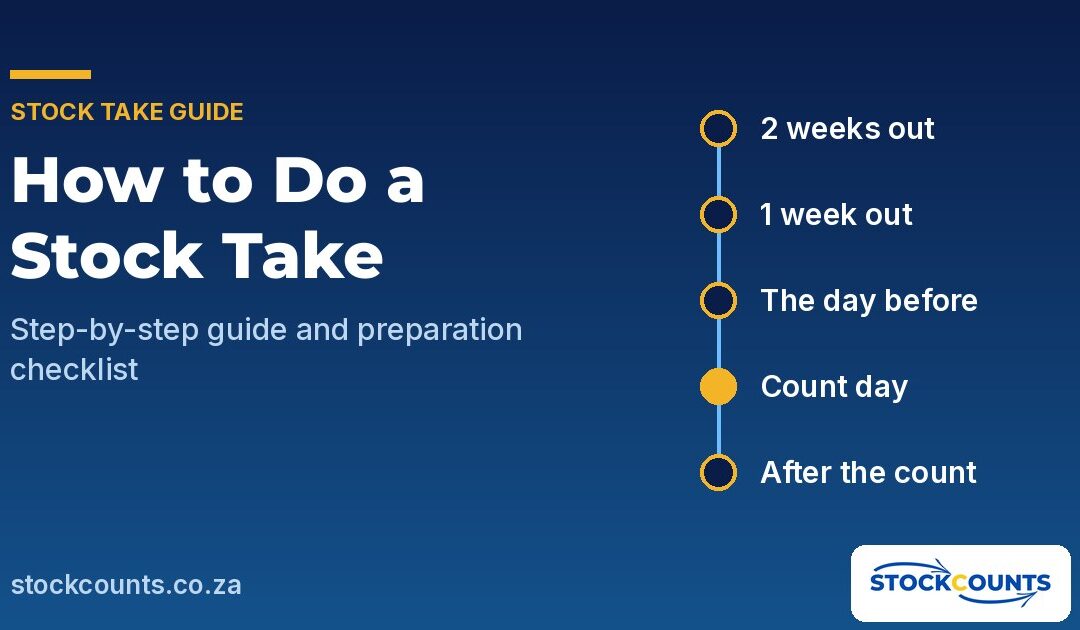
How to do a stock take: the timeline at a glance
| When | Main jobs |
|---|---|
| Two weeks out | Set the date, scope and cut-off, agree the count rules, book people and equipment |
| One week out | Tidy and consolidate, label bins, check barcodes, clear the paperwork backlog, prepare count sheets or devices |
| The day before | Process everything up to the cut-off, freeze stock movement, export expected quantities, brief your staff |
| Count day | Count blind, count twice, recount differences, sign off every area |
| After the count | Investigate variances, approve adjustments, reconcile, file the records |
Two weeks out: plan the count
Pick the date and time
Choose a time when trading, receiving and dispatch are at their quietest: after hours, a weekend or a public holiday. If your count is at financial year-end and you’re using an outside company, book early. December and February year-end dates fill up quickly.
Decide the scope
List every place stock is kept, not just the shop floor or the main racking. The usual forgotten spots are the back room, top shelves, display windows, the till counter, the returns area, off-site storage and the bakkie. Then decide how you’ll treat stock that isn’t straightforward:
- consignment stock (held by you, owned by a supplier)
- stock held for customers, such as lay-bys and paid orders not yet collected
- goods in transit between branches or from suppliers
- damaged, expired and non-stock items such as shop fittings and packaging
Set the cut-off
The cut-off is the exact date and time your count represents. Write it down and share it with receiving, dispatch, sales and accounts. Tell your regular suppliers about the delivery freeze, and agree where any late deliveries will be parked (unopened and clearly marked) so they aren’t counted by accident.
Agree the count rules
Most large variances come from unclear rules, not bad counting. Put them on one page before count day:
- Do you count cases or units? What about open boxes and split packs?
- Are consignment stock, samples and display items counted, counted separately or left out?
- What happens to unlabelled items or stock that isn’t on the system?
- Where do damaged and expired goods go, and are they counted?
When StockCounts runs your count, we agree these rules with you upfront through our take-on form, so everyone counts the same way. We also prefer to do a site visit before we quote, so the plan fits your actual layout and stock.
Book people and equipment
Plan counters in pairs, a supervisor for each area, and someone to check and capture the results. If you scan, make sure you have enough devices, chargers and spare batteries. If you’d rather count with your own team but don’t own scanners, you can rent preloaded devices from us, with training and remote support during the count.
One week out: get the site ready
Tidy and consolidate
Put like products together, close open boxes and face the shelves so counters aren’t also searching. Move damaged, expired and non-stock items to one clearly marked area. Stock split across several locations is the easiest stock to count twice or miss altogether.
Label shelves and bins
Give every aisle, bay, shelf and bin a unique location code, and label it. If you scan, use barcoded location labels. Draw a simple floor plan that splits the site into zones, so every area has an owner and you can see at a glance what’s been counted. For big sites, our warehouse stock take strategies explain zone counting in more detail.
Check barcodes
Scan a sample of products from every department. Replace missing or damaged barcodes, and check that the barcode in your system matches the product on the shelf. Make a list of items without barcodes so counters know how to handle them.
Clear the paperwork backlog
Capture outstanding GRVs, returns, transfers, supplier invoices, credit notes and write-offs now, not on the night before. The fewer documents left for the last day, the cleaner your system figures will be at the cut-off.
Prepare count sheets or devices
Set up count sheets or scanner sessions by location, and leave the system quantity off anything the counters will see. Load and test your devices on one aisle, so problems with labels or software are fixed before the whole team is waiting.
The day before: lock everything down
Process everything up to the cut-off
Every delivery, return, transfer and invoice dated before the cut-off must be on the system. Anything that arrives after it stays unopened in the marked area until the count is closed.
Freeze stock movement
From the cut-off, nothing is received, dispatched, transferred or moved between locations in the areas being counted. If you have to keep trading, record every sale and movement so it can be adjusted for.
Export the expected quantities
Take a snapshot of the system quantities at the cut-off, not the next morning. Keep it with the supervisor, away from the counters. When you give StockCounts your expected quantities, we can pull live variance reports at any stage of the count.
Brief your staff
A short, clear briefing prevents most counting errors. Cover who counts where, the count rules, the counting pattern, units of measure, how to flag a doubt, and break times. People count carefully when they understand why it matters. Read more on the human factor in accurate stock takes. Running a small shop with one or two helpers? Our small business inventory management guide has a simple routine for owner-run stores.
Count day: stock taking procedures that keep the count accurate
- Start with a quick recap. Remind teams of the rules and hand out their areas and sheets or devices.
- Count blind. Counters never see the system quantity. If they do, they tend to “find” the number they expect.
- Follow a fixed pattern. Work each shelf the same way, for example top to bottom and left to right, so nothing is skipped.
- Record the unit of measure. Always note whether you counted units, packs or cases, as agreed in the count rules.
- Count twice. Each location is counted a second time, ideally by a different person or team. This is how StockCounts works: every bin is counted twice by different teams, and our software compares both counts.
- Recount differences straight away. Where the two counts don’t match, recount that location before moving on, while the stock is still frozen.
- Mark each location as done. Tick it off on the floor plan or tag the shelf, so you always know which bins have been counted once, twice or not at all.
- Sign off every area. The supervisor checks that all locations in the zone are counted and signs before the team moves on.
After the count: variances, recounts and reconciliation
Compare the counts with the system
Once both counts agree, compare them with the expected quantities from your snapshot. Sort the differences by value, largest first, so your time goes where the money is.
Investigate before you adjust
Most variances are recording problems, not theft. Before you treat a difference as a loss, check:
- stock in the wrong location, or in an area that was missed
- cases counted as units, or the other way round
- deliveries, returns or sales captured on the wrong side of the cut-off
- transfers that left one branch but haven’t arrived at the other
- damages, samples and write-offs that were never recorded
Recount what you can’t explain
If a large difference survives the checks, recount the item and the locations around it before reopening the area.
Approve and post the adjustments
Someone other than the counter approves each adjustment, and every adjustment is posted with a reason. Avoid adjusting just “to make it match”. If you correct differences without finding the cause, they come back at the next count.
Reconcile, report and file
Reconcile the final counted value with your accounts, then keep the signed sheets or exports, the variance report and the adjustment list with your financial records. Your accountant will need them, and SARS record-keeping rules apply to records that support your tax return.
Fix the causes
Look for patterns: the same product, area, supplier or shift. Those point to the process you need to fix. Regular cycle counts between full stock takes keep your records accurate all year, and our inventory and inventory management guide covers the KPIs to track.
Printable stock take checklist
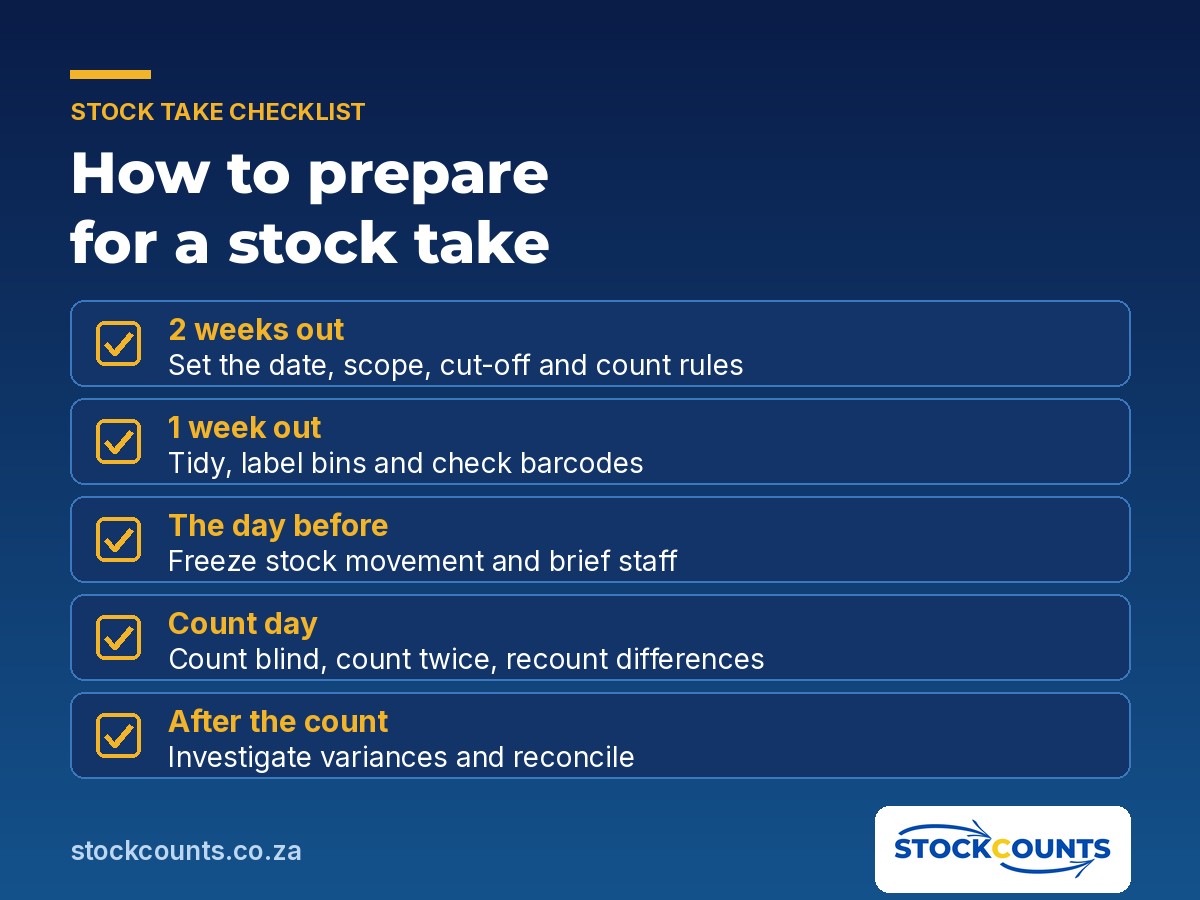
Print this stock take checklist, pin it up in the back office and tick it off as you go.
Two weeks out
- Date, time and scope agreed
- Cut-off written down and shared
- Count rules agreed (cases vs units, consignment, unlabelled, damaged)
- Counters, supervisors and equipment booked
One week out
- Site tidied, like products together, damaged stock separated
- Every bin labelled, floor plan and zones drawn
- Barcodes tested and fixed
- Paperwork backlog captured
- Count sheets or devices set up and tested
The day before
- All documents processed to the cut-off
- Stock movement frozen, late deliveries parked
- Expected quantities exported
- Staff briefed
Count day
- Blind counts, fixed pattern, units recorded
- Every location counted twice
- Differences recounted
- Every area signed off
After the count
- Variances investigated, largest first
- Adjustments approved with reasons
- Counts reconciled and records filed
- Causes noted and fixed
Download: Stock take preparation checklist (PDF, one page)
When to bring in professional stocktakers
Knowing how to do a stock take yourself is useful, and a well-prepared team can handle a small count. Consider outside help for your year-end count, large stores and warehouses, multi-branch counts, a business or franchise handover, or when you need an independent figure. Here’s how StockCounts helps:
- Site visit and take-on form. We prefer to visit before we quote, and we agree your count rules upfront.
- Every bin counted twice by different teams, with full bin control.
- Live variance reports at any stage of the count when you give us your expected quantities.
- After-hours, weekend and public-holiday counts, at different rates, so you don’t have to count during trading hours.
- Nationwide service from our base in Centurion. For counts outside Gauteng, travel and accommodation are calculated in your quote.
- Clean CSV exports that import into almost any inventory management system.
Frequently asked questions
How do you do a stock take, step by step?
Plan the date, scope and cut-off; agree the count rules; prepare the site by tidying, labelling bins and checking barcodes; process all paperwork and freeze stock movement at the cut-off; count every location blind and twice; recount any differences; then investigate variances, approve adjustments and reconcile the result with your records.
How far in advance should I prepare for a stock take?
Start about two weeks before the count. That gives you time to agree the date, scope, cut-off and count rules, book staff and equipment, and tidy and label the site. Use the week before for barcode checks and the paperwork backlog, and the day before for the cut-off, the stock freeze and the staff briefing.
Do I have to close my business to do a stock take?
Not always, but stock in the areas being counted must not move. Many businesses count after hours, over a weekend or on a public holiday. StockCounts offers after-hours, weekend and public-holiday counts at different rates, so you can count while you’re closed.
What should I do if the count doesn’t match the system?
Recount first, then rule out recording errors: stock in the wrong place, cases counted as units, documents captured on the wrong side of the cut-off and unrecorded transfers or damages. Only then treat the difference as a loss. Have someone other than the counter approve each adjustment, with a reason.
Can my own staff do the stock take?
Yes. Brief them on the count rules, use blind counts and have every location counted twice. If you don’t have scanners, you can rent preloaded devices from StockCounts with training and remote support. For year-end counts or handovers, a professional count gives you an independent figure.
Book your stock take with StockCounts
Now you know how to do a stock take, from the first plan to the final reconciliation. If you’d rather not run it yourself, book a professional stock take and we’ll plan it with you, from the site visit and take-on form to the final reports. Tell us your location, type of stock and preferred dates, and we’ll send you a quote.
Or contact us directly:
- Corné Vermaak (Director): 082 922 7173 / [email protected]
- Edward van der Merwe: 072 643 6425 / [email protected]
- Address: Falcon Crest Office Park, 142 South Street, Die Hoewes, Centurion, 0157
- Office hours: Monday to Friday, 08:00–17:00. We also count on weekends and public holidays (at different rates).
StockCounts is a division of Leka Rona Trading.